News
Postponing of the social elections procedure due to Covid-19
As already announced in our previous newsflashes, the social partners have decided to suspend the current social election procedure because of the coronavirus crisis and to restart the procedure after the summer.
On 24 March 2020, the National Labour Council (NLC) issued an opinion that highlighted the implications of this postponement for companies. This NLC opinion has now been transposed into a law which has been voted in Parliament on 23 April 2020.
This article outlines the most important consequences for employers.

Flemish wind turbine rules could infringe EU rules on prior environmental assessment
Advocate General Sánchez-Bordona has concluded in a recent legal opinion that several Flemish rules regarding wind turbines infringe the EU rules on prior environmental assessment.
Day X+35: the filing of the candidates’ lists
On X+35 at the latest (i.e. between 17 and 30 March 2020 depending on the chosen election day), the candidates’ lists per category of personnel (blue- and white collar workers, young workers and managerial personnel) must be filed with the employer by the recognised national trade unions (or their authorised agents), i.e. the ABVV/FGTB, ACV/CSC and ACLVB-CGLSB. For companies employing at least 15 managers (‘kaderleden/cadres’), the representative managers union (NCK/CNC) can file a separate list for managerial personnel or the managers can file an ‘internal list’ if such list is supported by at least 10% of the company’s managers (for the Works Council elections only).
Limits to privileged claims
A company (debtor) involved in reorganisation proceedings is in principle not protected against new claims that originate after the reorganisation proceedings have been opened.
The DPA approves a draft Act prohibiting life and health insurers from processing health sensor data
The Belgian data protection authority has approved a draft Act that prohibits life and health insurers from processing the health sensor data of their insurance holders.

To FIDIC or not to FIDIC? Five pitfalls for contractors to keep in mind
Working on an offshore wind power project in the Atlantic Ocean for the Japanese government but headquartered in Belgium? Flying over from Russia to construct Belgian railways by order of a French company?

Night work in e-commerce in 2020: nothing new under the sun?
With e-commerce growing at an unprecedented rate all over the globe, in the past few years the Belgian legislator has taken several measures – both temporary and permanent – to make Belgium a more attractive hub for e-commerce activities.

Lieven Peeters wins the Client Choice Award in 2020!
One of our Real Estate & Regulatory partners, Lieven Peeters, received the Client Choice Award 2020 for Leisure Industries in Belgium during an ILO event last week in London.

CJEU sheds light on the “Country of Origin” concept
In the run-up to the entry into force of specific rules on country of origin labelling for primary ingredients, the CJEU has recently clarified both the concept of the “country of origin” under the FIC Regulation and its interplay with other regulations such as the Regulation on the common organisation of the agricultural products markets and the Union Customs Code.

Day X: posting of the notice announcing the date of the elections
On day X, i.e. between 11 and 24 February 2020, depending on the chosen election day, the Works Council and/or the CPPW, or, in their absence, the employer, must provide the employees with the following written information:
(1) The name(s) and address(es) of the Technical Business Unit(s);
(2) The date and time schedule of the elections (day Y);
(3) The election calendar;
(4) The number of mandates for the Works Council and/or the CPPW per body and per category of employees;
(5) The person in charge of the distribution of the voting letters;
(6) The provisional voters’ lists or the place(s) where they can be consulted;
(7) The list of high-level executive personnel (‘leidinggevend personeel/personnel de direction’) (including their names and the content of their function) or the place where they can be consulted;
(8) The list of the managerial personnel (‘kaderleden/cadres’) (including their names and the content of their function) or the place where they can be consulted (for the Works Council election only);
(9) If applicable, the right to vote electronically.
Although this obligation relies on the Works Council and/or the CPPW, it is the employer that usually prepares the information, which is then posted after the approval of the Works Council and/or the CPPW.

Property law and real estate structures finally modernised: Book III of the Belgian Civil Code has been approved!
On 30 January 2020, the new Book III on Goods was approved by the Belgian parliament. What are Book III’s characteristics?

’Cash for car’ crashed
On 23 January 2020, the Constitutional Court annulled the law introducing a mobility allowance (cash for car).

New Belgian Act on medicinal product shortages
On 3 February 2020, the Belgian Act of 20 December 2019 amending various legal provisions concerning shortages of medicinal products was published in the Belgian State Gazette.
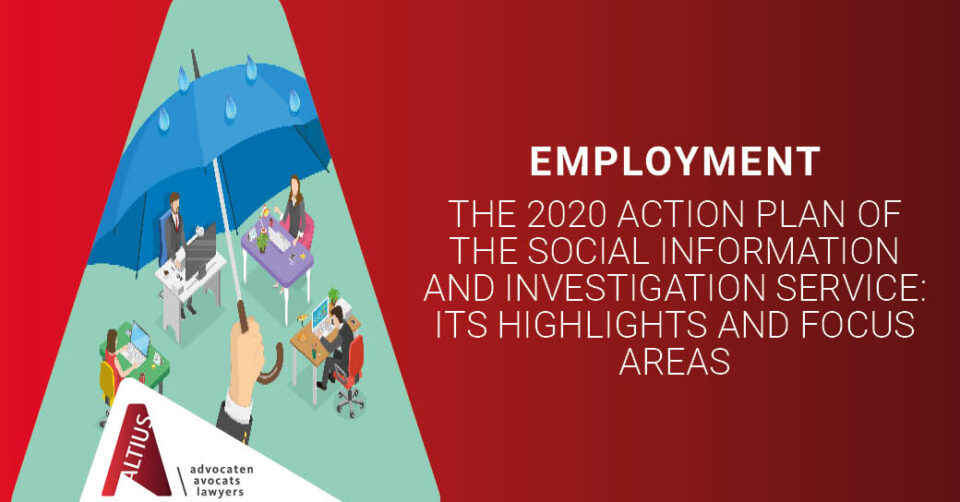
The 2020 Action Plan of the Social Information and Investigation Service : its highlights and focus areas
The Social Information and Investigation Service (“SIOD/SIRS”) has published its 2020 Action Plan “Fight against Social Fraud and Social Dumping”. This plan reveals the strategy and the top priorities of the inspection services for 2020. The 2020 Action Plan is built around five strategic objectives, resulting in 55 specific actions. We summarize the highlights of the 2020 Action Plan below so that you can see at a glance if and when your sector is being targeted this year.
ALTIUS has contributed to the 2020 Edition of the ‘European Employment Law Update’ that covers 34 countries in Europe
‘European Employment Law Update’ is an annual guide that compiles updates on employment law from leading law firms all over Europe.

ALTIUS appoints a new Counsel!
ALTIUS is proud to announce that Sophie Lens has been appointed as Counsel from January 2020.

Employers, be aware of the “hidden protection period” kick-off!
The “hidden protection period” is one of the most remarkable features of the social elections process. The hidden protection period is the period during which candidates already benefit from the specific dismissal protection, even though the candidate lists are only being disclosed to the employer 65 days later. Hence, there is a 65 days-gap during which an employer is not aware of an employee’s candidacy for the social elections and related dismissal protection, reason why it is highly recommended not to proceed with any dismissals during the hidden protection period to avoid a substantial financial liability.
Depending on your election date, the hidden protection period starts between 12 January and 25 January 2020.

Patenting blockchain
While much has been written already regarding blockchain and its many exciting applications for the future, not much has been said on how you can adequately and legally protect your blockchain once it has been developed.

The International Comparative Legal Guide to: Real Estate 2020
One of our partners, Lieven Peeters, is pleased to announce that the International Comparative Legal Guide to: Real Estate 2020 has been published.

Clawback: chasing assets
This article reflects on some of the options offered under Belgian law by the actio pauliana, commonly referred to in English as the ‘clawback’ rules.

X – 60: What are your obligations?
On X – 60, i.e. between 13 and 26 December 2019, depending on the chosen election day, the employer must provide the Works Council and/or the CPPW, or, in their absence, the Trade Union Delegation, with written information that includes the following elements:
(1) the determination of the (number of) ‘technical business unit(s)’ (TBUs)
(2) the number of employees per ‘category’ on day X – 60
(3) the functions of the high level executive personnel (‘leidinggevend personeel/personnel de direction’) and an indicative list of the persons exercising these functions
(4) the functions of the managerial personnel (‘kaderleden/cadres’) and an indicative list of the persons exercising these functions (only for the Works Council)
(5) the day of posting of the notice announcing the date of the elections and the envisaged date of the elections

The new Plant Health Regulation is ready to take off as of 14 December 2019
Pests threaten plant health. To fight the increased risks owing to the further globalisation of trade and climate change, the European legislature has adopted measures concerning the determination and reduction of risks imposed by pests: Regulation 2016/2031.

Is your company ready for the Incoterms 2020?
On 1 January 2020, the new Incoterms® 2020 as published by the International Chamber of Commerce (ICC) will come into force.

Whistleblowing employees soon to be protected against retaliation measures?
The Whistleblower Directive is a minimum level directive and must be implemented within 2 years after it enters into force (which as of today’s date is not yet the case).