Two kiwis a day to chase constipation away – European Commission approves fruit health claim
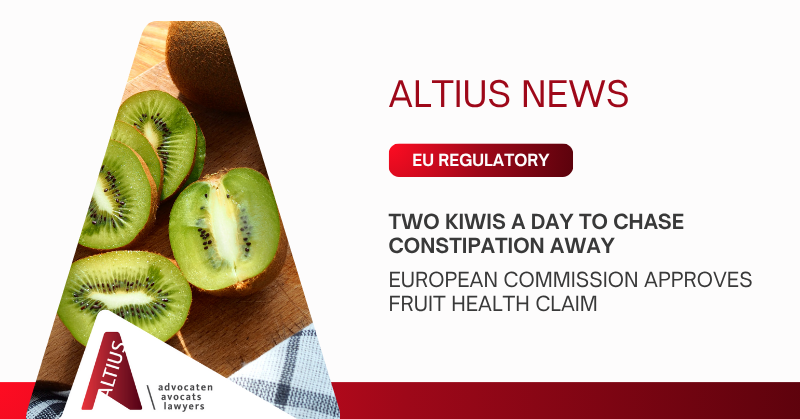
The European Commission has authorised a new food health claim recognising the digestive health benefits of green kiwifruit. The claim—“Consumption of green kiwifruit contributes to normal bowel function by increasing stool frequency”—has recently been added to the Union list of permitted claims under Regulation (EU) No 432/2012, following a five-year authorisation process.
Regulation 1924/2006 governs the EU’s very strict rules on nutrition and health claims for food. A health claim is any statement or implication that connects a food product, or one of its components, to health. Only claims backed by generally accepted scientific data that are understandable and meaningful to the average consumer may be used in commercial communications. Health claims are subject to a pre-authorisation process, which includes:
- a scientific assessment by the European Food Safety Authority (EFSA);
- Member State scrutiny; and
- final adoption by the Commission.
A long process for the kiwi claim
Zespri International Lt applied for the claim in 2020. After some back-and-forth and tweaking of the claim’s wording, EFSA concluded that “a cause and effect relationship [had] been established between the consumption of green kiwifruit (Actinidia deliciosa var. Hayward) and maintenance of normal defecation”. EFSA also noted that, to obtain the claimed effect, two large green kiwifruits (approximately 200 g of kiwi flesh) should be consumed daily. This part of the regulatory process took around nine months, with EFSA presenting its positive opinion in June 2021.
It then took another four years for the claim to clear the final hurdle: comitology. This a political procedure in which the Commission and Member States review and approve proposed authorisations.
It appears that the parties involved in the comitology struggled to translate EFSA’s comment on the required daily intake into practical conditions for use. They eventually settled on the following:
- The claim may be used only for (i) fresh green kiwifruits sold as such; or (ii) fresh green kiwifruits that have only been peeled and/or cut – providing a minimum of 200 g of kiwi flesh.
- Information must be given to the consumer that the beneficial effect is obtained with a daily intake of 200 g of fresh green kiwi flesh.
The authorisation was published on 31 July 2025.
Why the green kiwifruit health claim matters
The EU’s health claims framework is conservative, and it shows. First, it is very rare for a whole fruit—rather than an isolated component—to be linked to an authorised health claim. That fact alone shows how restrictive the framework is in practice. Second, the kiwi claim took five years to navigate the regulatory process. Few new claims are added to the EU list, and the authorisation of one—even for a widely consumed fruit—requires years of coordinated effort.
While the system is designed to safeguard consumers and ensure that claims are scientifically substantiated, this case suggests that the main obstacle was not the science itself—EFSA established a cause-and-effect relationship after 9 months —but the political process that followed. The process’s length and complexity call into question whether the EU health claims framework works as it should.
For further information, please contact Bregt Raus (bregt.raus@altius.com)
Written by

Recommended articles

Belgian Pharma Law Summer Blog Series (Part 3): the recently passed ‘Bill containing various provisions on health’
In our Belgian Pharma Law Summer Blog Series, we examine recent developments in Belgian pharmaceutical law. Whether you are looking for an informative summer read or a concise overview of the latest legal developments to catch up on after the holidays, our series has you covered. Our third and final part examines the ‘Bill containing […]
Read on
Belgian Pharma Law Summer Blog Series (Part 2): the new ‘Article 10 guidance’ on pharmaceutical promotion
In our Belgian Pharma Law Summer Blog Series, we examine recent developments in Belgian pharmaceutical law. Whether you are looking for an informative summer read or a concise overview of the latest legal developments to catch up on after the holidays, our series has you covered. Part 2 focuses on the new guidance on the […]
Read on
Belgian Pharma Law Summer Blog Series (Part 1): the Act of 30 May 2026 containing various provisions on medicinal and health products
In our Belgian Pharma Law Summer Blog Series, we examine recent developments in Belgian pharmaceutical law. Whether you are looking for an informative summer read or a concise overview of the latest legal developments to catch up on after the holidays, our series has you covered. Part 1 focuses on the Act of 30 May […]
Read on