Belgian pre-packs: practical challenges and opportunities for EU reform

Our lawyers, Bart Heynickx, Roel Verheyden and Chloe Wolff contributed the Belgian perspective to “Pre-packs become the EU standard”, a comparative feature exploring pre-pack procedures across several European jurisdictions. Published in INDat Report, issue 09/2026, on 5 November 2026, their contribution examines Belgium’s experience with pre-packs and how the new EU framework could address the practical challenges identified. An English translation of the Belgian contribution is set out below.
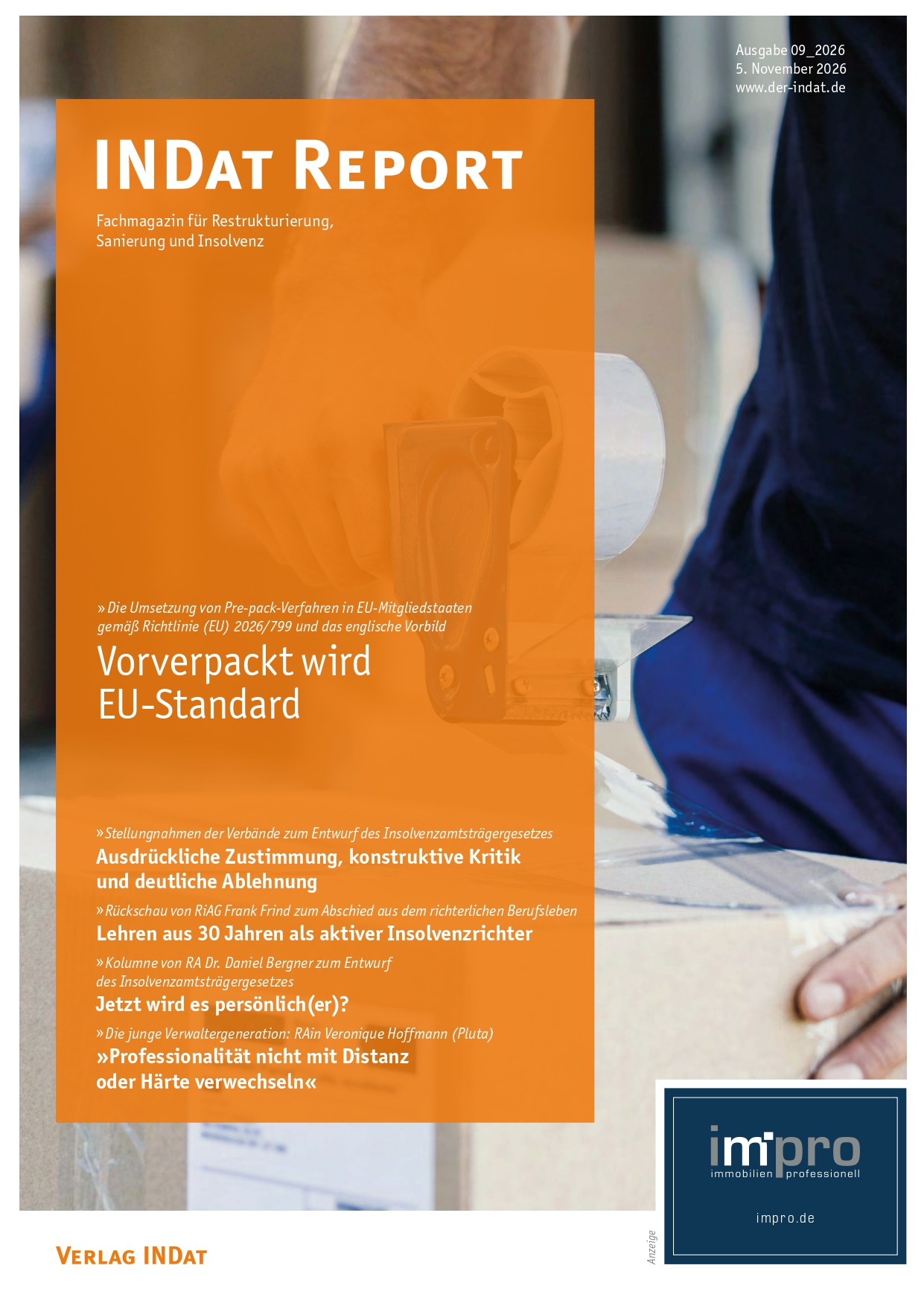
Cover of INDat Report, issue 09/2026, published by Verlag INDat.
Belgium is in the position of an EU Member State that has already introduced and tested a pre-pack procedure, the shortcomings of which, as identified in practice, can now be addressed through the transposition of Directive (EU) 2026/799. Since 1 September 2023, Belgium has had an established pre-pack procedure1, governed by Articles XX.97/1 to XX.97/6 of the Code of Economic Law, which already largely complies with the harmonised framework laid down in the Directive. Drawing on Belgian experience since 2023, this article examines the extent to which the Directive can address the main difficulties identified by Belgian practitioners in pre-pack proceedings: financing the preparation phase, protecting the business against protective and enforcement measures during that phase, and preserving contracts.
Financing the preparation phase
Belgian practice has identified a particular difficulty in financing the preparation phase of the transfer: funds provided at this stage do not, in principle, enjoy preferential status, exposing the provider of financing to the risk of a total loss if the transfer transaction fails.
Article 36 of the Directive offers potential solutions that will require action by the Belgian legislature when transposing the Directive. First, Article 36(2) and (3) provide for the possibility of priority satisfaction from security over the sale proceeds in favour of the provider of financing, which is of particular interest to Belgian practitioners. In a business that is already in financial distress, almost all available assets are generally encumbered by security interests. Priority of repayment independent of security rights in rem would become one of the few means of making interim financing attractive. However, this solution under the Directive is optional; its adoption depends entirely on the Belgian legislature’s decision and would be welcome.
Second, under Article 36 of the Directive, Member States must ensure that a provider of interim financing cannot be held liable solely on the ground that such financing is detrimental to the general body of creditors, without prejudice to other grounds of liability provided for under national law. No such ‘immunity from liability’ currently exists under Belgian law; a provider of interim financing is currently exposed to an action for increasing the liabilities or reducing the assets of the insolvency estate.
Protecting the business against protective or enforcement measures and preserving contracts
A further difficulty identified in Belgian practice is the absence, during the preparation phase, of statutory protection for the business against protective and enforcement measures, and for its ongoing contracts. Creditors retain the right to enforce their security, take protective or enforcement measures and apply for the opening of bankruptcy proceedings. In addition, the prospective purchaser must renegotiate separately with each counterparty to secure the continuation of ongoing contracts.
Two mechanisms under the Directive merit attention here. First, Article 25 of the Directive allows the debtor to benefit from a stay of individual enforcement actions; this mechanism, which which is not currently available during the preparation phase of the Belgian pre-pack procedure, would need to be implemented. Second, Article 30(1) of the Directive requires executory contracts necessary for the continuation of the business to be assigned to the purchaser without the counterparty’s consent, unless the purchaser is a competitor of that counterparty. The Directive allows Member States to provide for further exceptions. This mechanism would directly address the purchaser’s need to renegotiate each sensitive contract. Belgian practitioners would welcome its implementation by the legislature without the introduction of exceptions.
It is also noteworthy that Article 31 of the Directive establishes the principle that the purchaser acquires the business free of debts and liabilities, unless expressly agreed otherwise, subject to obligations arising from employment relationships. It should be emphasised that Article 31 departs from the approach under Belgian law governing judicial reorganisation by transfer of assets, one of the three Belgian judicial reorganisation procedures, under which debts were, in principle, included in the transfer of the contracts taken over. Given this departure from existing Belgian practice, we expect the legislature to make adjustments when transposing the Directive in order to maintain consistency with that approach.
- See the country report on Belgium in the forthcoming fifth edition of the Münchener Kommentar zur Insolvenzordnung, Volume 4. ↩︎



Recommended articles

Belgium’s Pre-Pack Procedure: A Two-Year Reality Check
Legal framework Pre-packaged sales, or “pre-packs,” have long been utilized in the United Kingdom and the United States as a restructuring mechanism that enables the sale of a distressed business to be arranged prior to the commencement of formal insolvency proceedings. The objective is to preserve the company’s value by facilitating its sale as a […]
Read on
New measures to address over-indebtedness and protect companies in difficulty
On 1 July 2024, the Act of 15 May 2024 on measures to address over-indebtedness and protect companies in difficulty was published in the Belgian Official State Gazette. The main amendments of the Act, as well as its entry into force, are briefly discussed below.
Read on
New insolvency landscape on the horizon: more options for companies to reorganise and restructure
Belgium had accumulated a significant legislative backlog within insolvency law. The European Directive 2019/1023 on restructuring had to be transposed into national law by the member states by 17 July 2022 at the latest. The Belgian government did not submit a draft bill to this effect until 20 March 2023. This draft has since been voted into law and will enter into force on 1 September 2023.
Read on